6.8.21
We went to Bozeman mainly to see our daughter Maya, working a temporary management stint at a Comfort Suites there for a few weeks. Good to see her after way too long — she already had pizza ordered by the time we pulled in, and we spent the evening eating and catching up on family gossip, which is to say, news.
Bozeman’s a good-looking town, small without feeling rural, the Bridger Mountains visible out of nearly every window in the place. Easy to understand why celebrities keep ranches around here — apparently they’re a common enough sight around town that nobody makes a fuss over them. Hotel was fully booked, so we parked the trailer in the lot and Maya let us use her room for showers. Met some of her coworkers and her boss. There’s something satisfying about watching your kid operate in a grown-up role — she runs that place with real authority, staff, customers, vendors, money and facilities all on her.
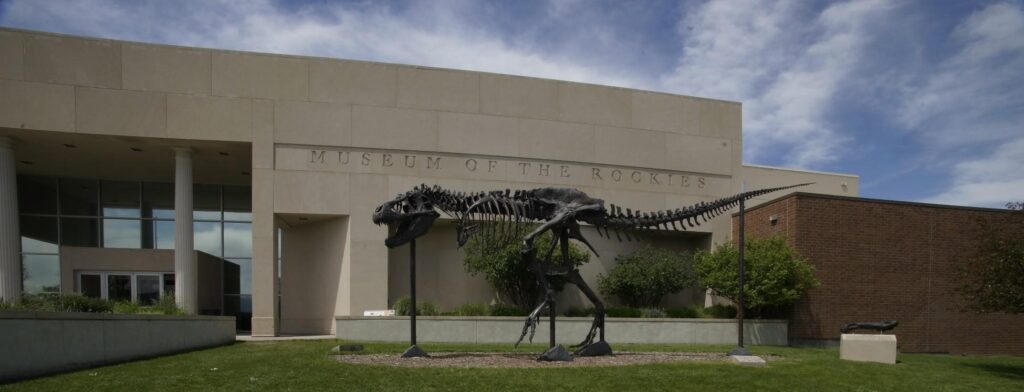
We’d heard the Museum of the Rockies had a serious dinosaur collection, and we went in thinking, well, we’re from Chicago, we’ve been to the Field Museum, hard to top that. Turns out this place does top it, easily.
Started with a planetarium show on the Voyager mission — decent, though between the narrator’s smooth delivery and the ambient music, staying alert was a real effort. Then into the dinosaur hall proper.
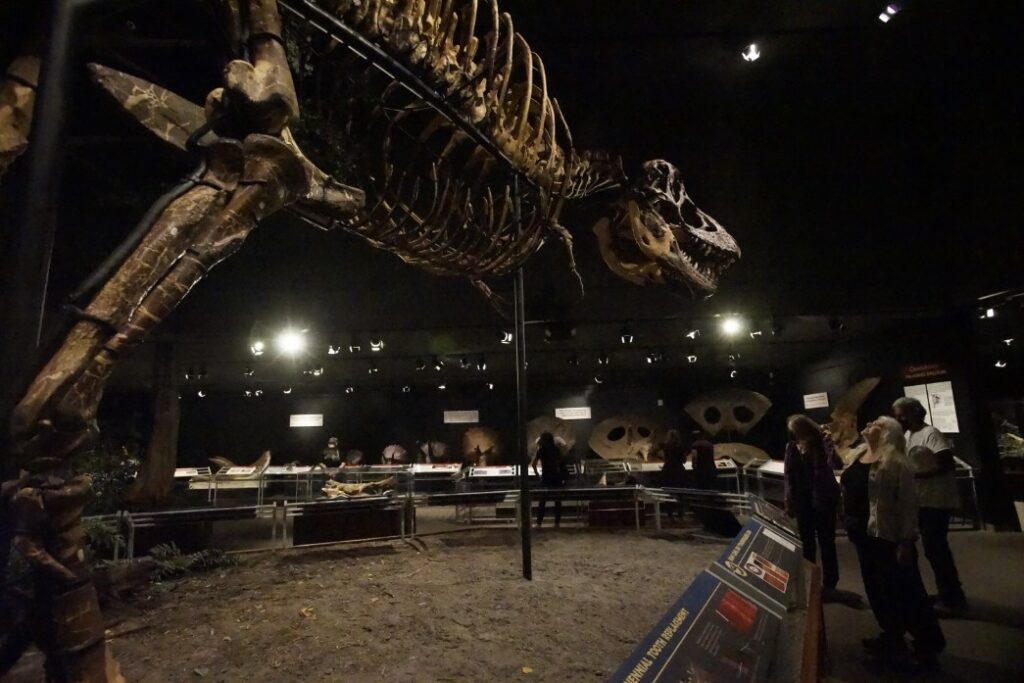
Huge exhibit, specimens in various stages of assembly, color-coded so you can tell original bone from reconstruction. Their T-rex is 60% original bone, which is remarkable given how rare that is. Exhibits walked through what the skeletons reveal about life cycle, diet, social behavior, cause of death. Most of the finds came out of Montana, and the stories behind the discoveries were as good as the fossils themselves — a lot of young volunteers and grad students making these finds, which got me thinking about the thrill of pulling a chunk of bone out of a desert dig and realizing it’s a priceless piece of prehistory.
Full skeletons, partial ones showing growth stages, egg clutches, individual eggs. Several exhibits made the case, based on blood vessel patterns in the bone, that some of these animals carried keratin on the outside — same material as hair, nails, and beaks — for instance around a Triceratops’ neck frill. Since keratin runs bright in nature (a toucan’s beak, for one), it’s entirely possible these animals were vividly colored rather than the uniform green-gray we’ve always pictured. One display showed the raw bones of a predator-prey encounter on
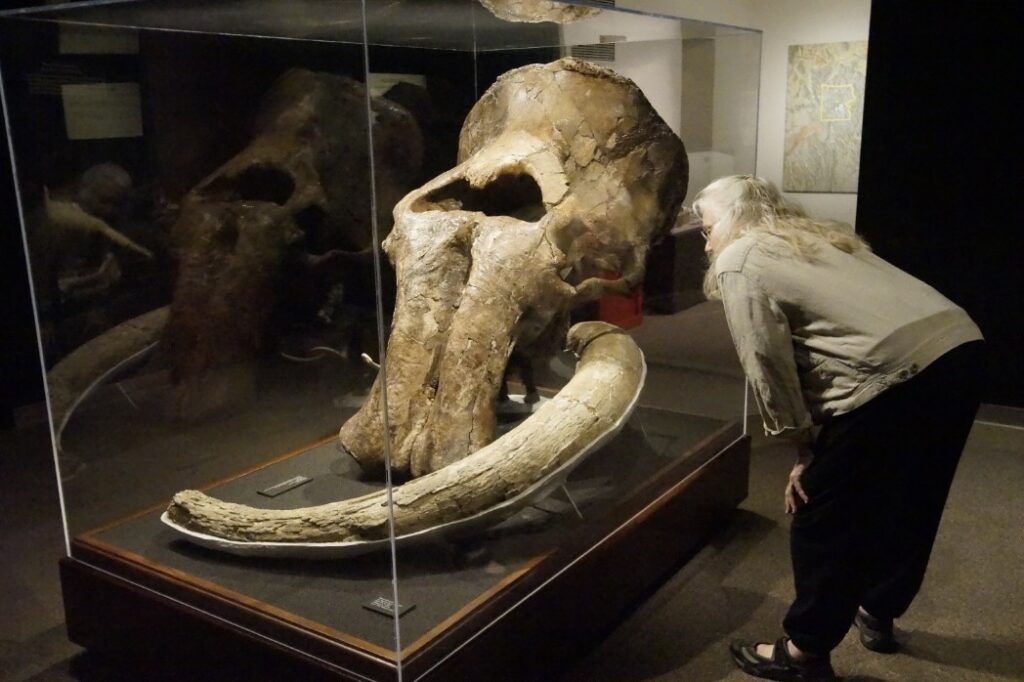
one side, and on the other, an artist’s rendering of both animals with bright keratin coverings and primitive feathering, more like a horse’s mane than a lizard’s hide.
There was a glassed-in working lab where a scientist — white-haired, yarmulke, lab coat — was actively restoring the leg bones of a large specimen, including a four-foot femur. He came out to talk to a group of kids about what the bones could tell you, clearly in his element, infectious enthusiasm, good with the audience.
A lot to take in. We went looking for food after.
No cafeteria in the museum itself, but they pointed us to a food truck outside — Montana State runs one called Fork in the Road, doing steady business. Worth the wait despite having food of our own along. I had a wild rice and butternut squash bowl with salmon; Lu had street tacos, also salmon, both lightly seasoned with onion and tomato. Hibiscus tea, huckleberry lemonade. Cherry hand pies for dessert, plus some kind of whole-wheat tart with raspberry jam that I
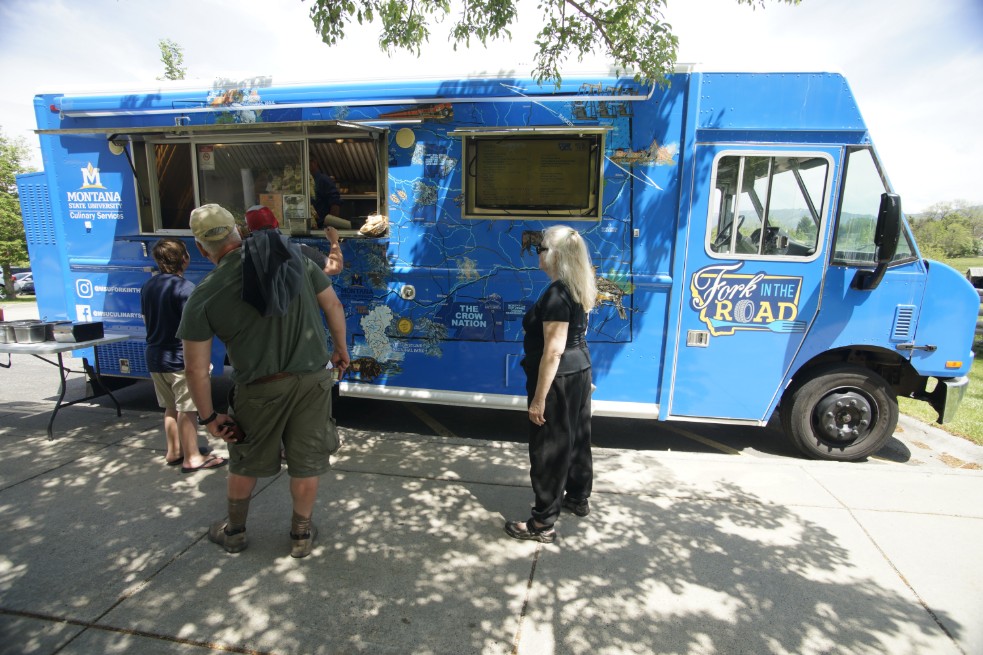
gathered was a local specialty. The outdoor tables were in direct sun, so we ate on the grass under a tree in the parking area instead. Good lunch, and we needed the break.
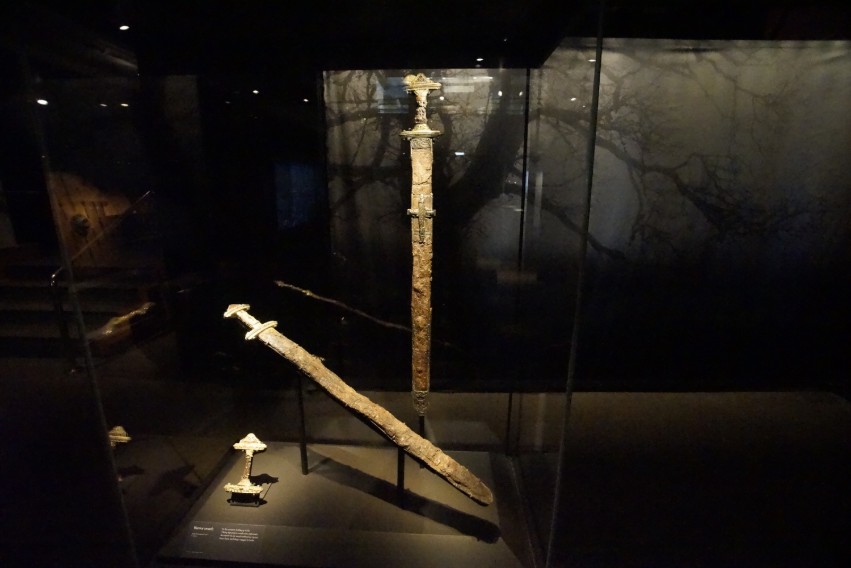
Afternoon brought a Viking exhibit — dramatic music, some reenactment footage, but noticeably light on actual artifacts, like the concept got further along than the collection did. Weapons, decorated swords, a replica funeral boat. What stuck with me was a scepter head found in a woman’s grave, with an explanation that Viking women held the role of spiritual and magical authority in that society.
There was also a section on early settler housing, including a full-scale example from the 1920s-30s
showing construction methods that made housing affordable while still holding up to the elements, plus a replica tar-paper shack from an earlier era. I don’t envy anyone who spent a Montana winter night in one of those. The museum closed with a thorough Native American history exhibit — contemporary replicas of traditional clothing, detailed beadwork, video and text narrated by Native people themselves about preserving their culture going forward.