6.10.21
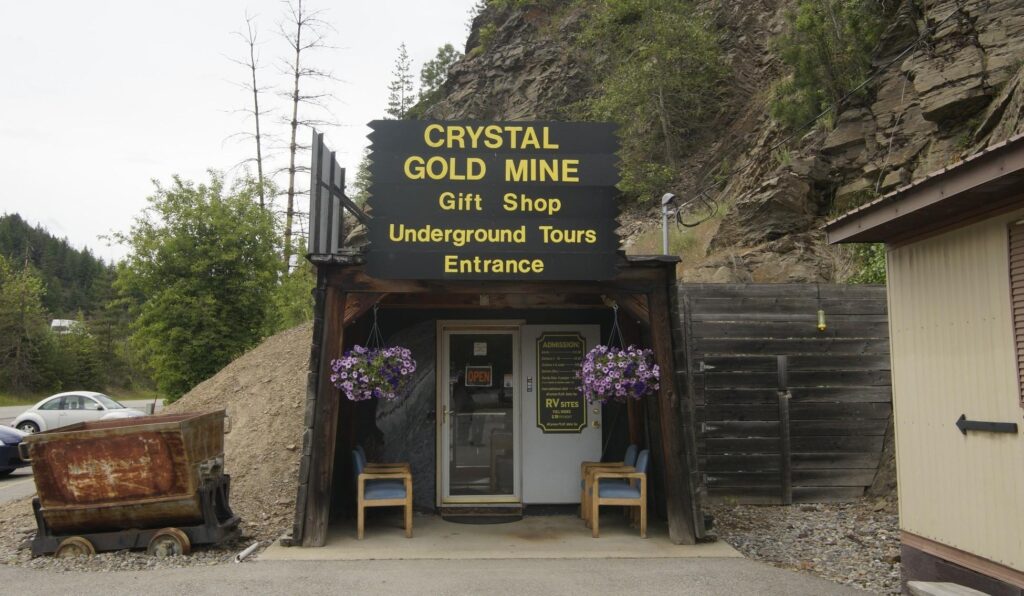
Sounds like a roadside gimmick, doesn’t it — the Crystal Gold Mine and RV Park. But it’s a genuine gold mine in the Idaho panhandle, with about 20 RV hookups tacked on.
We’ve done a diamond mine in Arkansas, a coal mine in Nova Scotia, and two copper mines up in Michigan’s UP, but never gold until now. This one has an odd history — worked sometime in the late 1880s, abandoned, eventually boarded up for safety and forgotten, then rediscovered in the 1960s.
Ray owns the place and runs the tours himself. Everybody gets a hardhat and a flashlight, and the hardhats carry goofy Old West and cartoon names — Trapper, Doc, Sneezy. I was Bam Bam; Lu got Clem. Smart system, really — lets him call out to visitors by name without having to actually learn who anyone is for the hour they’re with him, and I’d guess it’s handy for keeping a group of kids’ attention too, since he mentioned they run a lot of family and school tours. Gold panning tubs sit out front for anyone who wants to try the actual technique miners used to sift crushed rock for flecks of gold.
Ray’s a genuine mining history nut, delivers the whole area’s history in a rapid-fire, almost salesman patter — “Step right up, folks, look at this.” He explained the region carries plenty of silver alongside the gold, some of it right here in this mine, but back in the 1880s there was no local way to process silver, so they only bothered with gold. A big quartz vein runs through the mine and that’s where both metals show up — you can still
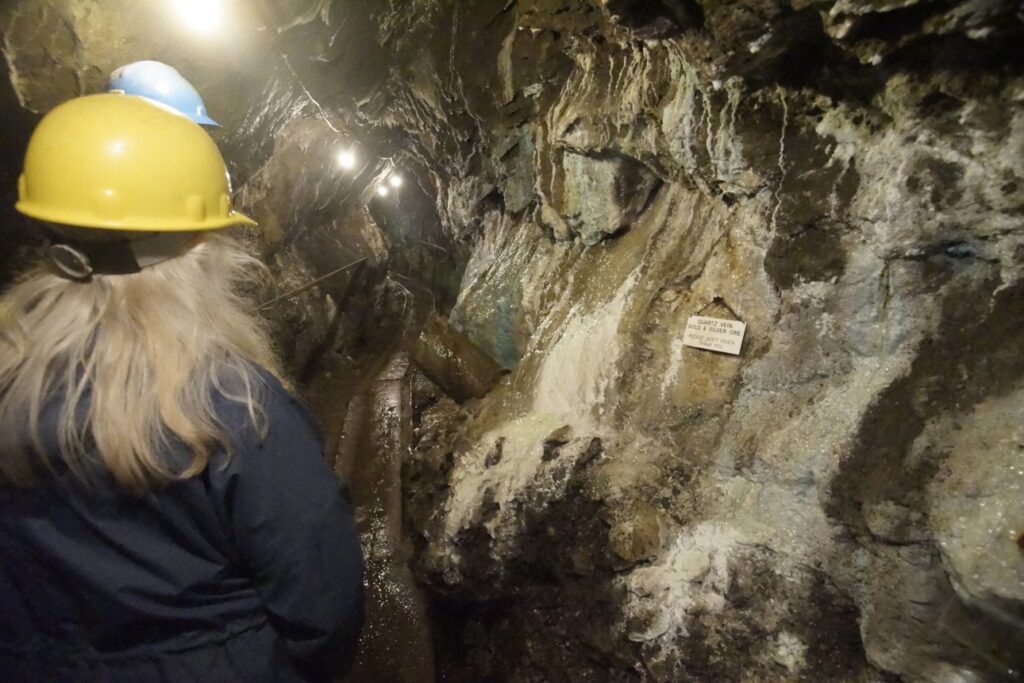
spot gold and silver embedded in the walls if you look closely, which is what the flashlights are for since the mine’s otherwise lit electrically. Some fool’s gold — iron pyrite — mixed in too, though it’s not hard to tell apart once you know real gold runs a mellower sheen against pyrite’s brassy shine.
They worked the quartz with shovel and chisel by candlelight, hauling rock outside periodically to check for gold. Some of the original tools are still down there. Their candleholders were simple twisted iron pieces with the candle extending both directions
— the actual origin, apparently, of “burning the candle at both ends,” which would’ve meant one very long, hard day underground. Every mine tour eventually cuts the lights to let you feel real darkness; Ray lit a candle for the moment instead, pointing out the miners would’ve struck matches, not flicked a Bic, and wedged it into a rock crevice. Dynamite came into play for opening new sections — pack it, light the fuse, and run like hell for the entrance or the nearest side tunnel until it went off.
Ray filled in more of the mine’s backstory. Locals knew something was underground here for years without being sure what. At one point the land changed hands and geologists came through, took samples, and concluded there was nothing worth pursuing.
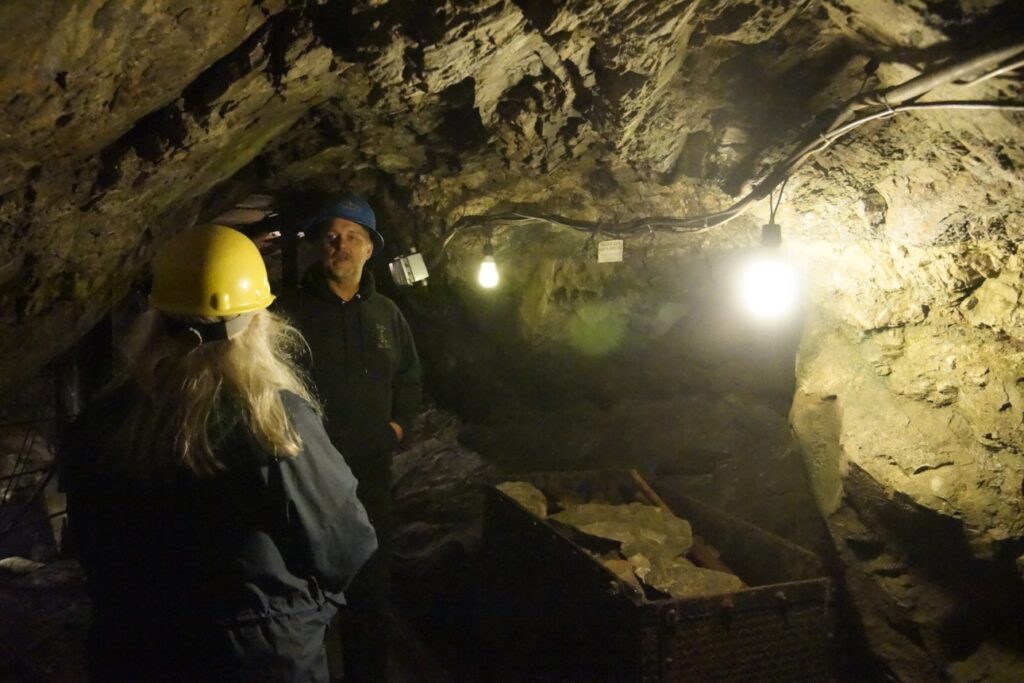
Turns out they were wrong — the mine still has rail tracks from the ore cars, missed by multiple inspections over the years. A later owner did work the quartz and gold for a
stretch and opened an enlarged tunnel as a tourist draw by the mid-1960s. Eventually Ray
and his wife bought the property outright and decided to preserve it strictly as a historical site rather than keep mining it.
The geology’s still active down there — stalactites, stalagmites, and colored streaks where minerals leach through the quartz: green for copper, blue for zinc, red for iron, black for silver, plus dark green patches that turned out to be moss rather than mineral, growing off the extra humidity and light from tourist traffic. Photos didn’t come out well given the mine lighting, which is a shame — the colors held up against some actual caves we’ve toured. In a few spots the owners left gold and silver exposed in the rock so visitors could see and touch what it would’ve looked like throughout.
The mine runs out about 500 feet from the entrance, 900 feet underground at that point. Nobody knows for certain who the original miners were or exactly when they worked, or why they quit. Ray’s still researching it, working on a book. Carbon dating on the wooden supports left behind — some of which have started petrifying — suggests the mine might go back as far as the 1870s. As for why they stopped, he floated a few theories: partnership disputes, injury or death, given how short miner life expectancy ran from lung disease after years of breathing rock dust. Doesn’t look like this operation demanded quite the labor the UP copper mines did — Ray figures five or six men could’ve cleared what’s here as it stood in the 1960s, before later tourist expansions — but it was still brutal work, and whatever gold they found may not have justified pushing it further.
There’s still gold and silver down there. The vein still runs through the mountain. Ray’s take is that the historical value of the place outweighs whatever’s left to extract, and given the labor it’d take, I’d agree with him.